
01 / OBSERVE↗

PHYSICAL MEASUREMENT
Instrumentation & imaging
From energy and wave phenomena to imaging and quantification, explore what sensors can measure and how uncertainty affects interpretation.
Software engineering, scalable cloud systems, numerical computing and data interchange grounded in physical science and biological context.
Physics provides mathematical models of forces, waves, transport and energy; biology provides complex systems to study. Technology connects both through scientific code, numerical simulation, secure cloud infrastructure, integration interfaces and verifiable data pipelines.
These are publicly described engineering disciplines and research interests—not announcements of commissioned platforms, validated devices, operational healthcare deployments or undisclosed methods.
Tools can expand what is observable, but evidence and experimental design determine what can reasonably be concluded.
From energy and wave phenomena to imaging and quantification, explore what sensors can measure and how uncertainty affects interpretation.
Study sampling, frequency, filtering, calibration and limits of inference when physical measurements meet physiological activity.
Investigate scientific software, versioned algorithms, numerical solvers and simulation workflows with explicit assumptions and validation.
Consider secure infrastructure, API design, distributed processing, integration engines and traceable exchange across clinical and research systems.
Research is strongest when technology supports biological interpretation rather than replacing it.
 SCIENTIFIC EVALUATION / HUMAN CONTEXT
Medical information is more than a dataset. It represents real anatomy, physiology, interpretation and clinical processes that demand clear safeguards.
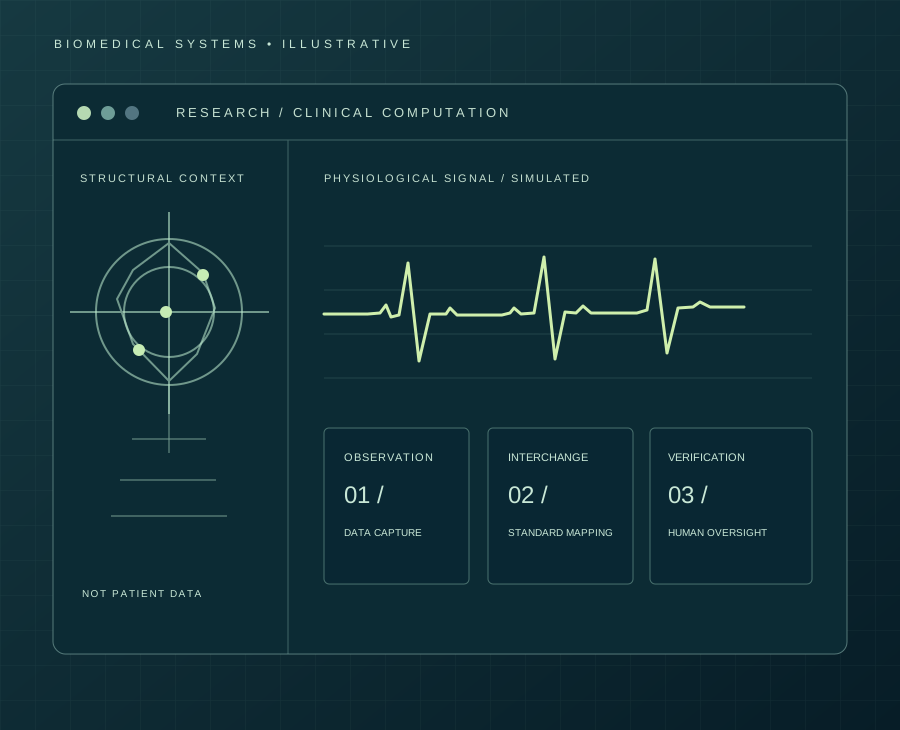
Scientific software engineering includes well-defined health data structures, validation of exchange workflows, image processing, numerical analysis and reviewable documentation.
Responsible research computing spans the software lifecycle, infrastructure, interface design and ongoing verification.
Modular services, typed data contracts, numerical libraries, version control, automated tests and reproducible build pipelines.
Architecture for controlled workloads, encrypted storage, scalable processing, reliable backups and monitored environments.
Clear specifications, data mapping, interface engines and standards-aware exchange between scientific and clinical contexts.
The systems described are engineering fields of interest, not claims that any particular production system is already deployed by anovalyx.